New Music Detroit: Strange and Beautiful Music VII

New Music Detroit will present Strange Beautiful Music VII this Saturday (Sept. 13, 2014).

New Music Detroit will host a 6-hour event for new music including two world premieres: John Zorn’s “Trilogy” and a work by Detroit native, Frank Pahl.  New York-based violinist, Todd Reynolds, will join us for a set of composition and improvisation.  NMD will perform Detroit’s premiere of David Lang’s “Death Speaks”  with special guest, Shara Worden. Also featured are GVSU’s New Music Ensemble, Miles Brown Quartet, Donald Sinta Sax Quartet, and Clem Fortuna.

Get more details on the NMD website.

NPR: New music from “My Brightest Diamond”

My Brightest Diamond’s new album, This Is My Hand, comes out Sept. 16.

“Worden’s music feels simultaneously micro-orchestrated and entirely, ecstatically spontaneous. She has in common with former bandmate Sufjan Stevens an exceptional knack for world-building, as well as an ability to cultivate intimacy through flawless, complex production with a beating heart. This Is My Hand is a paean to the work of human hands, in the same way 2011’s All Things Will Unwind celebrates beauty born of human struggle.”

Read the whole article at npr.org

Up Close with Michel van der Aa

michevanderaa

If you have a spare 30 minutes (because in this day and age 30 minutes of extra time is easy to come by), you may want to check out this concerto for cello, by Michel van der Aa, a dutch composer who was the recipient of the 2013 University of Louisville Grawemeyer award. Titled ‘Up Close’, this piece could be considered more of a film opera than a concerto. That being said, it is imperative that you watch the accompanying video along with listening to the music.

Feel free to share your comments below. Maybe we can get an interesting discussion going!

https://www.youtube.com/watch?v=5gwfpRm9YyU

24 Hours of John Zorn

john-zorn

Q2 Music, the contemporary music radio station associated with New York Public Radio, is celebrating the 61st birthday of John Zorn with a 24-hour marathon of his music tomorrow (Friday, September 5). This is actually a rebroadcast of their 60th birthday celebration from last September, but in case you’d like to listen to some great music and support a wonderful radio station, check out the website where you can stream it here:

http://www.wqxr.org/#!/series/q2/

Zorn is the host, so you will also get to hear commentary from the composer about his works!

Statements


Our new album, Statements, featuring all music of MSU composers, is now available online and in print. The first run of 1,000 copies is circulating among members of the studio, and can be obtained free of charge. Special thanks to Mark Sullivan for the photographs, Philip Rice for the jacket design, and Justin Rito for heading up the whole operation. The full album can be heard online and downloaded for free via Bandcamp.

The Met Museum: Janet Cardiff’s “Forty Part Motet”

FortyPartMotet2

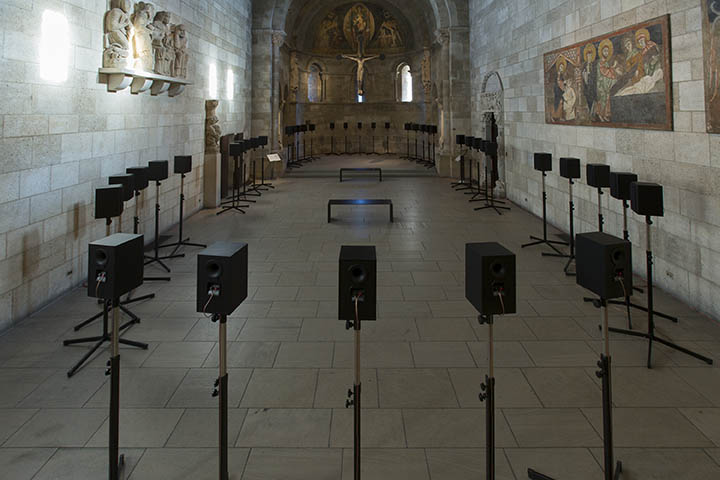
The Forty Part Motet (2001), a sound installation by Janet Cardiff (Canadian, born 1957), was the first presentation of contemporary art at The Cloisters. Regarded as the artist’s masterwork, and consisting of forty high-fidelity speakers positioned on stands in a large oval configuration throughout the Fuentidueña Chapel, the fourteen-minute work, with a three-minute spoken interlude, continuously played an eleven-minute reworking of the forty-part motet Spem in alium numquam habui (1556?/1573?) by Tudor composer Thomas Tallis (ca. 1505–1585). Spem in alium, which translates as “In No Other Is My Hope,” is perhaps Tallis’s most famous composition. Visitors were encouraged to walk among the loudspeakers and hear the individual unaccompanied voices—bass, baritone, alto, tenor, and child soprano—one part per speaker—as well as the polyphonic choral effect of the combined singers in an immersive experience. The Forty Part Motet is most often presented in a neutral gallery setting, but in this case the setting was the Cloisters’ Fuentidueña Chapel, which features the late twelfth-century apse from the church of San Martín at Fuentidueña, near Segovia, Spain, on permanent loan from the Spanish Government. Set within a churchlike gallery space, and with superb acoustics, it has for more than fifty years proved a fine venue for concerts of early music.

Of the work, Cardiff says,

“While listening to a concert you are normally seated in front of the choir, in traditional audience position. With this piece I want the audience to be able to experience a piece of music from the viewpoint of the singers. Every performer hears a unique mix of the piece of music. Enabling the audience to move throughout the space allows them to be intimately connected with the voices. It also reveals the piece of music as a changing construct. As well I am interested in how sound may physically construct a space in a sculptural way and how a viewer may choose a path through this physical yet virtual space. I placed the speakers around the room in an oval so that the listener would be able to really feel the sculptural construction of the piece by Tallis. You can hear the sound move from one choir to another, jumping back and forth, echoing each other and then experience the overwhelming feeling as the sound waves hit you when all of the singers are singing.”

http://www.metmuseum.org/exhibitions/listings/2013/janet-cardiff
Music in Vernacular Photographs

i listen to the wind that obliterates my traces

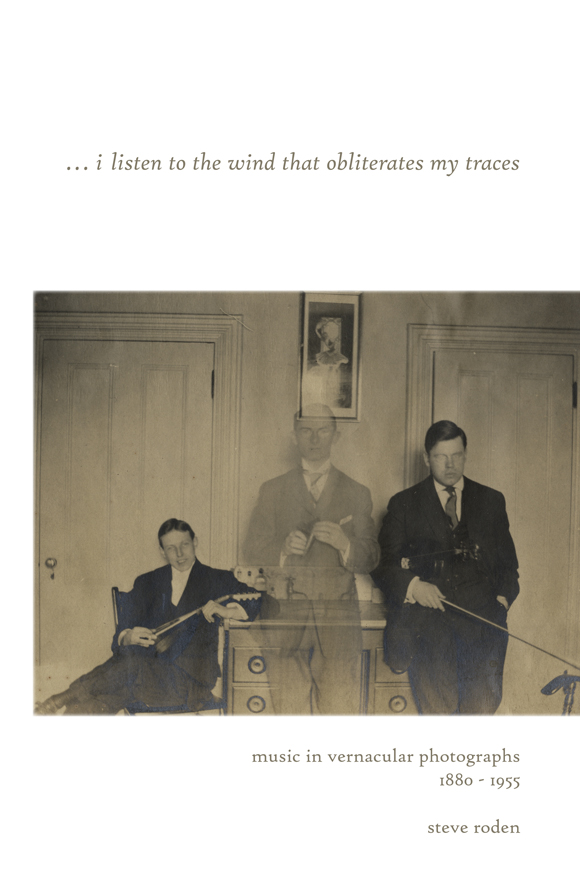
“…i listen to the wind that obliterates my traces: music in vernacular photographs” is a fascinating multimedia work by Steve Roden. I received a copy for my birthday this year from my best friend.

The collection is whimsical, unique, and deeply moving. Unlike a traditional poetry or essay anthology, photograph collection, or album, the book/CD set blurs the lines between text, images, and music/sound effects. The book doesn’t have a table of contents or chapters. The photographs don’t have captions. The associations between sounds, words, and pictures are made by the reader/listener. Interacting with the very object of the book becomes a kind of interpretative act, which the author mediates by means of curation.

This piece makes me wonder how can music become a thing we touch like a book, or a text we read? How can collecting and transmitting sound sound to an audience make composers into curators?

The Getty: “A New York Soundtrack for a New York Painting”

Mural, 1943, Jackson Pollock (American, 1912–1956). Oil on canvas, 8’ ¼” x 19’ 10”. University of Iowa Museum of Art, Gift of Peggy Guggenheim, 1959.6 Reproduced with permission from The University of Iowa

“[W]e’re using the Getty Center’s late summer hours to explore the connections between music and the visual arts. Having such a vibrant painting like Pollock’s Mural on view gives us an especially wonderful opportunity to understand how music and art operate as artistic mediums in relation to each other.”

[read more]